VICIfast

VICIdial clusters

VICIdial clusters, sized from real load

A VICIdial cluster runs one call center across several servers: a database and web server that every dialer shares, and dialer servers that run Asterisk and carry the calls and the agents’ phones. VICIfast sizes it from load we have measured, builds it on dedicated machines in one datacenter, and runs it with you.

Hardware is billed monthly at live prices: a two-dialer cluster with a standby database is $1,536 a month today. Building and running it is quoted on a sizing call.

calls and agents per dialer
300 + 25
calls’ worth of real queries on one database, 0.77 ms at the 99th percentile
≈1,260
a month in hardware for 900 calls, 75 agents
$1,755

Moving from another provider

Problems with your current VICIdial cluster, and how we fix them

Most of these come from how a cluster is set up and looked after, not from VICIdial itself. Each is something we have measured on a live floor, and fixed.

On the floor

Dispositions save late, or the screen hangs after a status is picked
VICIdial keeps its call records in MyISAM tables, which lock the whole table while a read runs. A report, a stats tool or a lead search that reads the call log for a few seconds makes every disposition wait behind it. On a 60-agent floor we measured, one day-long count held up to 334 statements for as long as 4 seconds.
What we do: We find what holds the call tables during a shift and take it off the floor’s path. Every cluster we build also gets the phone-number index VICIdial’s lead search is missing, so a search by phone no longer reads the whole call log.
Calls drop while agents sit ready
VICIdial hands each answered call to a free agent through the database. When the tables it needs are locked, the hand-off waits, but the drop timer keeps counting.
What we do: We find the calls left waiting while an agent was free and trace each one to what held the database up. On one floor, taking a stats tool off the call log cut lock waits from 58 a second to 13.
Agent screens freeze or stop updating
The agent screen asks the server for news every second. When the database or Asterisk’s manager interface backs up, those requests queue and the screen stops moving. Asterisk 21 and 22 also leak a manager subscription on every dialplan reload while the old users.conf file is present; after days of reloads that can trip Asterisk’s overload protection, which turns away new calls and phone registrations.
What we do: We have fixed that leak on every server we run, and the cluster page names any agent whose screen has stopped responding.

Audio and calls

Choppy audio on busy dialers
Linux’s default network buffers are sized for a desktop. On a busy dialer they overflow in bursts and voice packets are thrown away: one 60-agent server we measured had dropped 458,000 of them in four days.
What we do: Every server gets buffers sized for hundreds of calls, and every machine in the cluster talks to the others over a private network in one datacenter.
Customers connected to silence
When an agent’s browser phone loses its connection (a closed tab, a sleeping laptop, a new IP address), Asterisk keeps its side of the call up. VICIdial still sees a ready agent and keeps sending customers to a line nobody hears.
What we do: Every agent phone and carrier trunk hangs up after two minutes without audio, and the cluster page lists any call left connected with nobody on it.
Leave 3-way fails, or transfers get stuck
VICIdial frees conference rooms with a background process that is often left switched off. Without it, every room used for a 3-way call stays taken until the dialer has none left.
What we do: It runs on every dialer we build, and the cluster page shows how many conference rooms each dialer has free.

Knowing what is going on

Nobody can say why the floor had a bad day
In a cluster, a problem on the database shows up as a symptom on a dialer, while the usual server graphs (CPU, memory) look fine throughout.
What we do: The cluster page checks every server every 10 seconds and says in plain words when something needs a person. When a shift goes wrong, we can record the next one second by second (database locks, each dialer’s load, every call that waited) and show you the cause.
The drop rate doesn’t match VICIdial’s own report
Some dashboards divide dropped calls by every number dialed. VICIdial’s report divides by the calls a person answered, the rate drop limits are measured against. For one campaign that was 1.23% on a dashboard and 28.89% in VICIdial, on the same day.
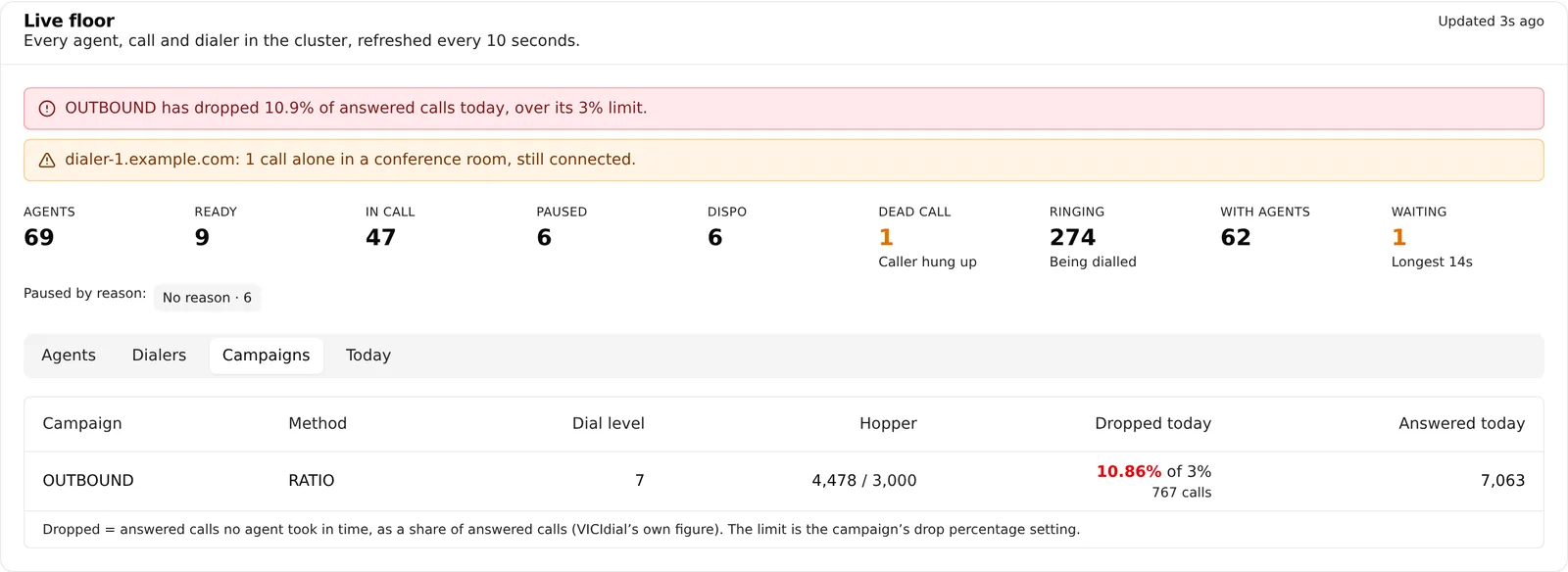
What we do: Our dashboard uses the same rate as VICIdial’s report, and each campaign shows its drops against the limit it is set to.
The hopper runs dry and agents sit idle
When a campaign’s hopper empties, the dialer has nothing to dial, and nothing on the agent screen says why.
What we do: The cluster page warns when a hopper is about to run dry, while there is still time to load leads or reset a list.

Upkeep

Security patches arrive late
Patching a live call center means touching servers mid-shift, so it gets put off.
What we do: When the PHP2Shell flaw reached VICIdial servers in October 2026, we patched every server we run within a day.
Upgrades wipe your custom changes
Upgrading VICIdial replaces its files, including the ones you or your provider changed.
What we do: A new VICIdial revision runs on our demo server first and is tested end to end. Your changed files are merged with the new version rather than overwritten, and servers are upgraded only when nobody is logged in.
One failed server stops the whole floor
With one database and one dialer, either machine failing stops every call.
What we do: At least two dialers and a standby database that copies every change as it happens, so a failed machine stops part of the floor, not all of it.

Single server or cluster

When one VICIdial server stops being enough

Past about 600 calls

By our estimates one machine carries about 600 concurrent calls with room to spare. Beyond that, the calls belong on dialers of their own.

Asterisk and MariaDB compete

On one box the phones and the database share the same cores, so a busy report or a list load slows the calls. A cluster gives each its own machine.

One box is one failure

With two or more dialers and a standby database, a failed machine stops part of the floor, not all of it.

Still deciding? Single-server vs clustered VICIdial, explained · or start on one bare metal machine.

Architecture

How a VICIdial cluster fits together

Database + web
MariaDB holds every lead, campaign and call record. The same machine serves the VICIdial admin, the agent screens and reports.
Dialer
Asterisk places and answers the calls and hosts the agents’ phones and conferences. One per 300 calls or 25 agents, and at least two.
Standby database
Replicates the database as it changes, so it can take over if the database machine fails.
One location
Every machine sits in the same datacenter on a private network. The dialers query the database many times a second; a round trip between Germany and Finland (over 20 ms) would stall them.
Your carriersSIP trunks: calls in and out
Your agentsA browser and a softphone each

Dialers · add one per 300 calls or 25 agents

Dialer 1Asterisk, agent phones, conferences
Dialer 2Asterisk, agent phones, conferences
Dialer 3Asterisk, agent phones, conferences
Database + webMariaDB, the VICIdial admin, agent screens and reports. Agents' browsers load their screen from here.
replicates
Standby databaseA live copy, promoted if the database machine fails
A VICIdial cluster on dedicated machines in one location. Carriers and agents connect to the dialers; every dialer reads and writes one shared database over a private network, and a standby copy follows it.

Your cluster, live

See the whole cluster on one page

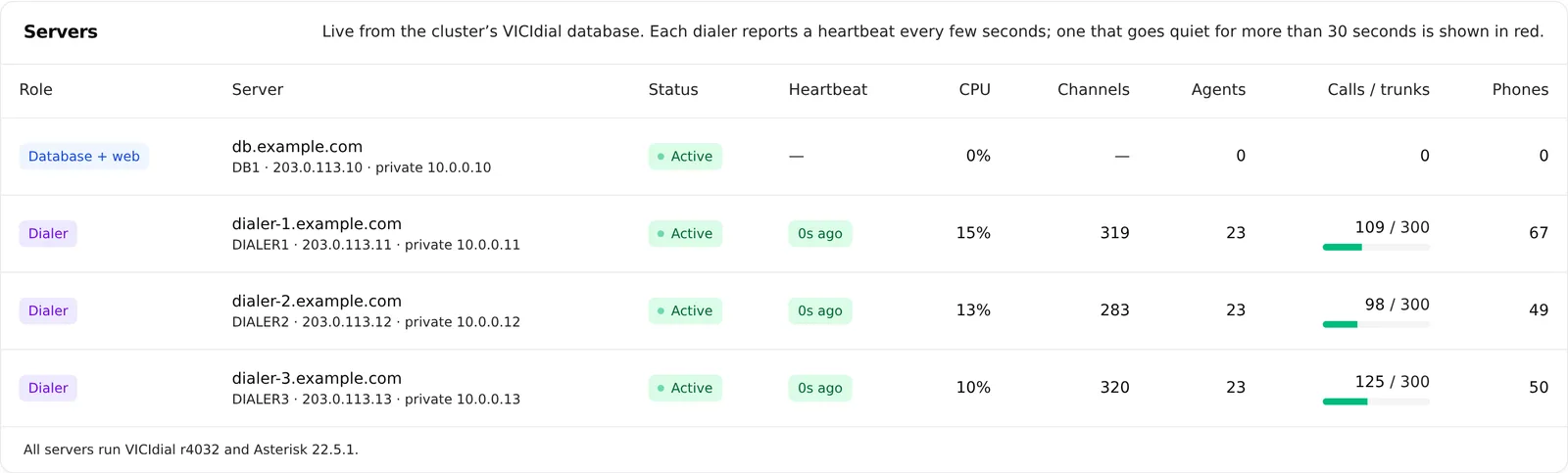
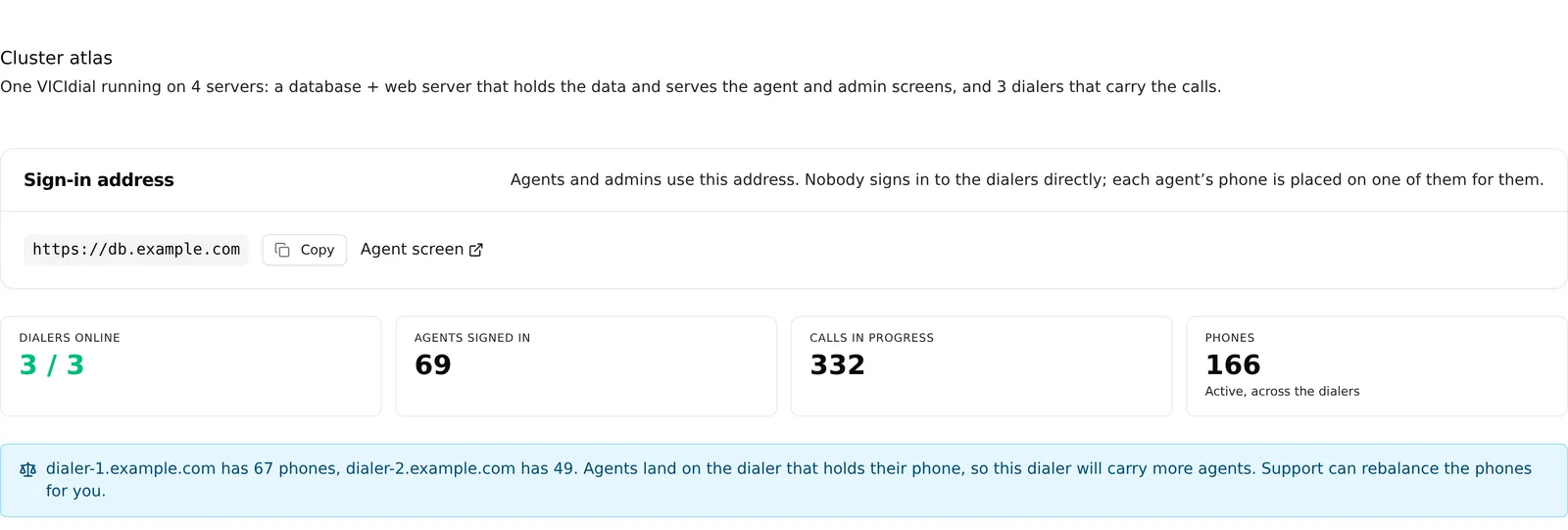
A cluster is several servers, but you watch it as one. Your VICIfast dashboard has a page for it that checks every server every 10 seconds and says, in plain words, when something needs a person.

Is anything wrong?
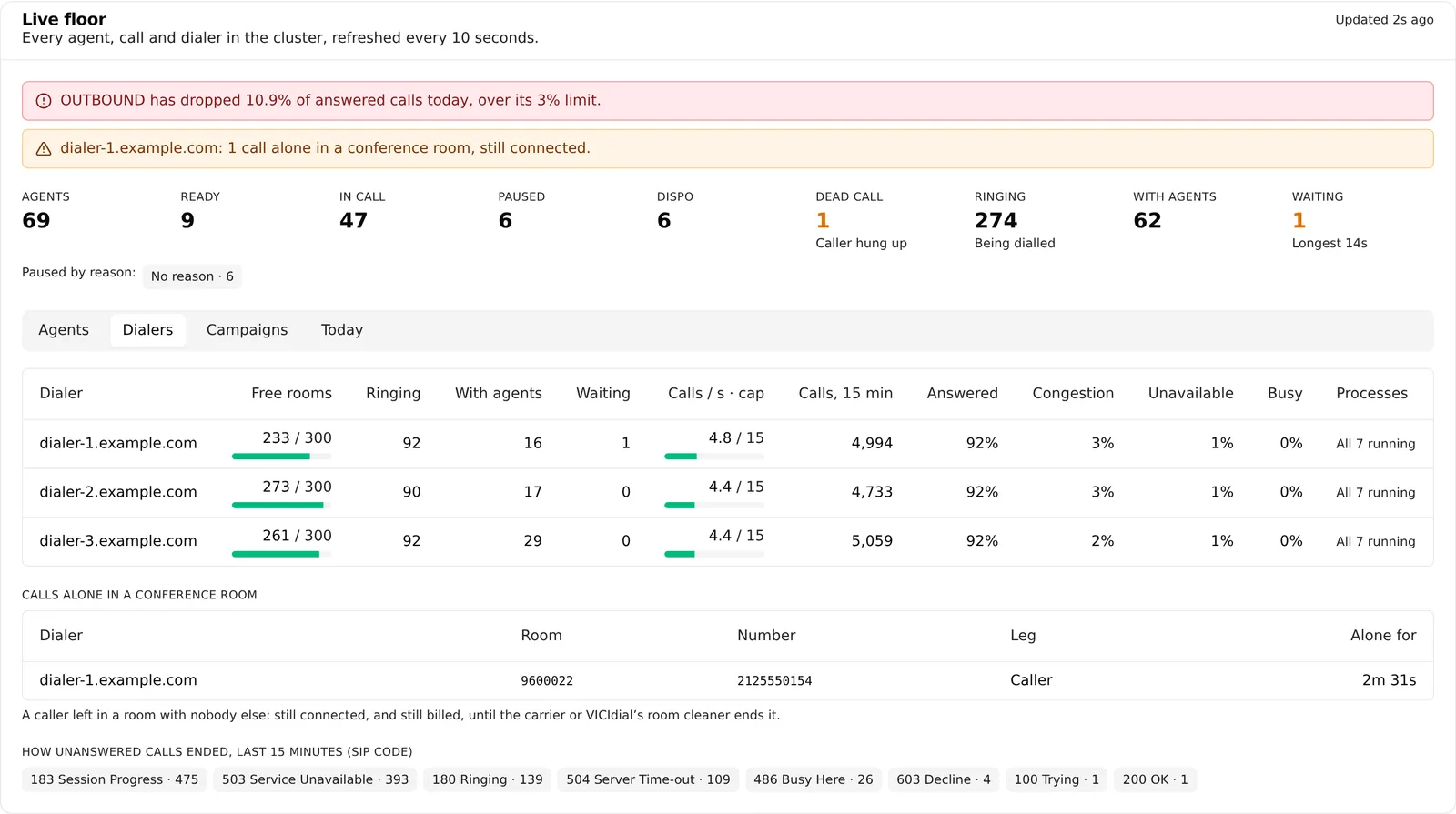
A red or amber line for each problem, worst first: an agent screen that stopped responding, a dialer running out of conference rooms (so Leave 3-way would fail), a VICIdial process that stopped, a call left connected with nobody on it, a campaign over its drop limit, a hopper about to run dry.
Who is doing what
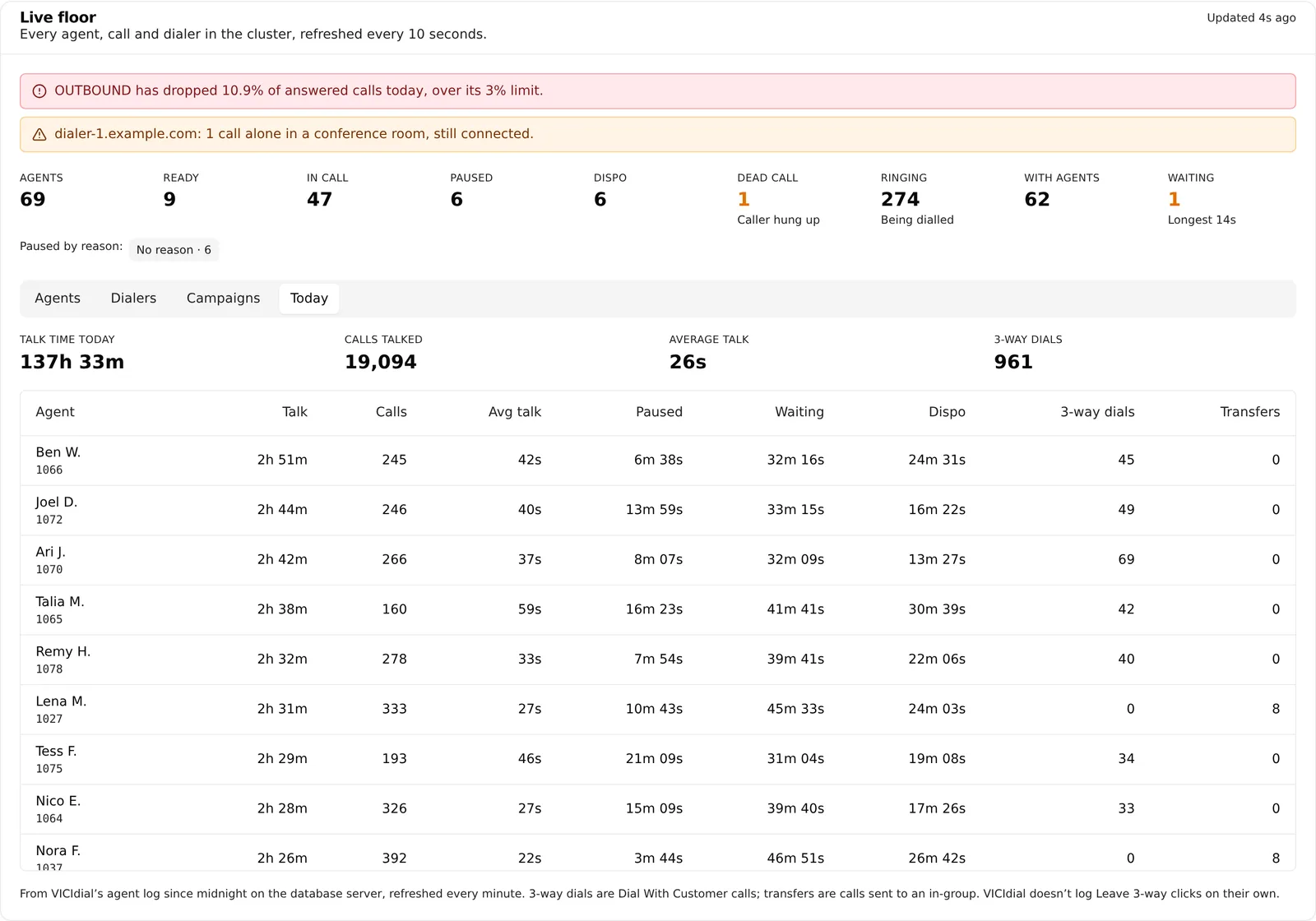
Every agent, what they are doing and for how long, in the colours of VICIdial’s own Real-Time report. The longest paused and the longest waiting are pulled out so a floor manager sees them first.
Where the calls are
How many are ringing, how many are with agents, how many are waiting for one, and how long the longest has waited.
How each dialer is coping
Free conference rooms, calls per second against its limit, how the last 15 minutes of calls ended at the carrier, and whether VICIdial’s background processes are all running.
How each campaign is running
The dial level, the leads left in the hopper, and dropped calls against the limit the campaign is set to.
How the day went
Talk time, calls, pauses, waiting and transfers for each agent since midnight.

Screenshots from a customer’s live cluster: three dialers and about 70 agents on a weekday afternoon. Server names, addresses, agents’ names and phone numbers are changed; the figures are real.

Size it

Size your VICIdial cluster

Move the sliders to your busiest minute. The machines and prices are today’s, from our Bare Metal catalogue.

Location
Every machine in a cluster sits in one location: the dialers talk to the database all the time.

5 machines

All in Finland

  • 1 × Database + web

    MariaDB, the VICIdial admin, agent screens and reports

    AMD Ryzen 9 7950X3D · 16 cores / 32 threads · 128 GB · 2 × 1.92 TB NVMe

    $549a month

  • 1 × Standby database

    A live copy of the database, ready to take over

    AMD Ryzen 9 7950X3D · 16 cores / 32 threads · 128 GB · 2 × 1.92 TB NVMe

    $549a month

  • 3 × Dialer

    Asterisk: carrier calls, agent phones and conferences

    AMD Ryzen 7 PRO 8700GE · 8 cores / 16 threads · 64 GB · 2 × 512 GB NVMe

    $657$219 each

Each dialer: about 300 calls and 25 agents (we size 300 + 25).

Slowest machine: Several weeks

$1,755/mo

hardware, + $475 one-time machine setup

Book a sizing call

Hardware is billed monthly at these prices. Building and running the cluster is quoted on the call.

Measured, not guessed

The load behind these numbers

Much of the VICIdial sizing advice online is rules of thumb. Ours starts from a live floor we measured, and a database we pushed until it showed its limits.

A live floor, measured

166 calls on 7.5 cores

An outbound floor on one of our 16-vCPU servers, over a full shift on 14 October 2026 (92 five-minute samples with calls up).

Concurrent calls
166
Agents
17
Channels
365
Asterisk
4.3 cores
MariaDB
1.3 cores
Database queries
2,230/s

Asterisk does most of the work; the database grows with every call too. That is what our per-machine call estimates are scaled from: about 2 cores of fixed load plus 0.03 cores per concurrent call, adjusted for each processor.

One database, pushed to 7×

15,083 queries/s on 2.1 cores

We replayed 5 minutes of that floor’s real database traffic on a 16-core AMD Ryzen 9 7950X3D, 128 GB, mirrored NVMe machine, faster and faster (15 October 2026).

Database replay results by speed
Speed≈ CallsQueries/sDB cores avg / peak99%99.9%
1×1802,1550.4 / 1.30.45 ms18 ms
3×5406,4641.1 / 2.10.6 ms24 ms
5×90010,7741.6 / 2.50.69 ms208 ms
7×1,26015,0832.1 / 3.10.77 ms290 ms

“≈ Calls” is the floor each speed stands for. The database never needed more than 3.1 of its cores; the slow tail at 5× and 7× came from table locks on VICIdial’s call log, not the processor. At this size the fix is keeping that table small with VICIdial’s log archiving, not a bigger database.

Example clusters

Three VICIdial clusters, priced today

Each with a standby database, in the location where every machine is in stock for less. Hardware only: building and running the cluster is quoted.

Two-dialer floor

600 concurrent calls · 50 agents

  • 1 × Database + webAMD Ryzen 9 7950X3D, 128 GB$549
  • 1 × Standby databaseAMD Ryzen 9 7950X3D, 128 GB$549
  • 2 × DialerAMD Ryzen 7 PRO 8700GE, 64 GB$438

$1,536/mo

4 machines · + $416 one-time machine setup

FinlandSeveral weeks

Three-dialer floor

900 concurrent calls · 75 agents

  • 1 × Database + webAMD Ryzen 9 7950X3D, 128 GB$549
  • 1 × Standby databaseAMD Ryzen 9 7950X3D, 128 GB$549
  • 3 × DialerAMD Ryzen 7 PRO 8700GE, 64 GB$657

$1,755/mo

5 machines · + $475 one-time machine setup

FinlandSeveral weeks

Five-dialer floor

1,500 concurrent calls · 125 agents

  • 1 × Database + webAMD Ryzen 9 7950X3D, 128 GB$549
  • 1 × Standby databaseAMD Ryzen 9 7950X3D, 128 GB$549
  • 5 × DialerAMD Ryzen 7 PRO 8700GE, 64 GB$1,095

$2,193/mo

7 machines · + $593 one-time machine setup

FinlandSeveral weeks

How we build it

From sizing call to a live floor

  1. 1

    A sizing call

    Your agents, dial level, inbound and recording. We come back with a layout and a monthly price.

  2. 2

    Machines in one location

    We order every machine from the datacenter together, on one private network. Delivery estimates are shown before you commit.

  3. 3

    Database first

    We install the database and web machine and start the standby replicating, then join each dialer to the cluster.

  4. 4

    Tested on your carriers

    Test calls through your own trunks and a pilot campaign, before the floor moves.

  5. 5

    Your data moved across

    Leads, lists, campaigns and recordings from your current VICIdial, on a date you choose. Migrations are quoted with the cluster.

  6. 6

    Run with you

    Monitoring, patching and a named contact, on the terms in your agreement.

Prefer cloud servers? We build clusters on our cloud plans too. The capacity calculator designs one, and Enterprise covers contracts, SLAs and multi-region.

FAQ

Questions, answered straight

One VICIdial system spread over several servers. A database server holds the data every part of VICIdial shares and, in our layout, also serves the admin and the agent screens; dialer servers run Asterisk and carry the calls and the agents’ phones. Agents log in and campaigns run the same way as on one server.

When one server cannot carry the floor, or when one server failing would stop it. By our estimates a single machine carries about 600 concurrent calls; past that, or if you want a standby database, run a cluster.

One for every 300 concurrent calls or 25 agents, whichever needs more, and never fewer than two, so one failing does not stop every call. 900 calls and 75 agents is three dialers.

We use a 16-core machine with 128 GB of memory and mirrored NVMe disks. In our replay of a live floor’s database traffic it carried about 1,260 calls’ worth of queries on 2.1 cores on average, with 99% of queries finishing in under 0.77 ms.

No. The dialers query the database many times a second, and the round trip between two datacenters (over 20 ms between Germany and Finland) is enough to stall VICIdial. Every machine in a cluster sits in one location, on a private network.

If a dialer fails, the calls on it drop and the other dialers keep the floor working. If the database machine fails, the standby database is promoted to take its place. Recovery times are written into your agreement.

Usually because something is reading the call log. VICIdial’s call tables are MyISAM, which lock the whole table during a read, so a report, a stats tool or a lead search that scans the log makes every disposition wait until it finishes. We find what holds the call tables during a shift and take it off the floor’s path, and every cluster we build gets the phone-number index VICIdial’s lead search is missing.

There are two common causes. The dialer may be placing more calls than the floor can take, which is pacing. Or the database is locked, so the hand-off to a free agent waits until the drop timer runs out. For the second, we trace the dropped calls to the query that held the lock and remove it.

The machines are billed monthly at live prices: today a 900-call, three-dialer cluster with a standby database is $1,755 a month in hardware, plus a one-time setup fee per machine. Building and running the cluster is quoted on a sizing call.

Yes, and most floors do. When you outgrow one machine we build the cluster beside it and move your data across on a date you choose; the migration is quoted with the cluster.

Need a migration from another host or a custom contract? Talk to VICIfast.

Tell us your floor. We’ll come back with a cluster.

A layout, the machines and a monthly price, from the numbers on this page.

Book a sizing call