The guide
Caller ID reputation, Spam Likely and VICIdial, answered.
By the VICIfast engineering team. Last reviewed 5 November 2026. Outside facts are dated and listed under Sources at the end.
What is the DID Reputation Center?
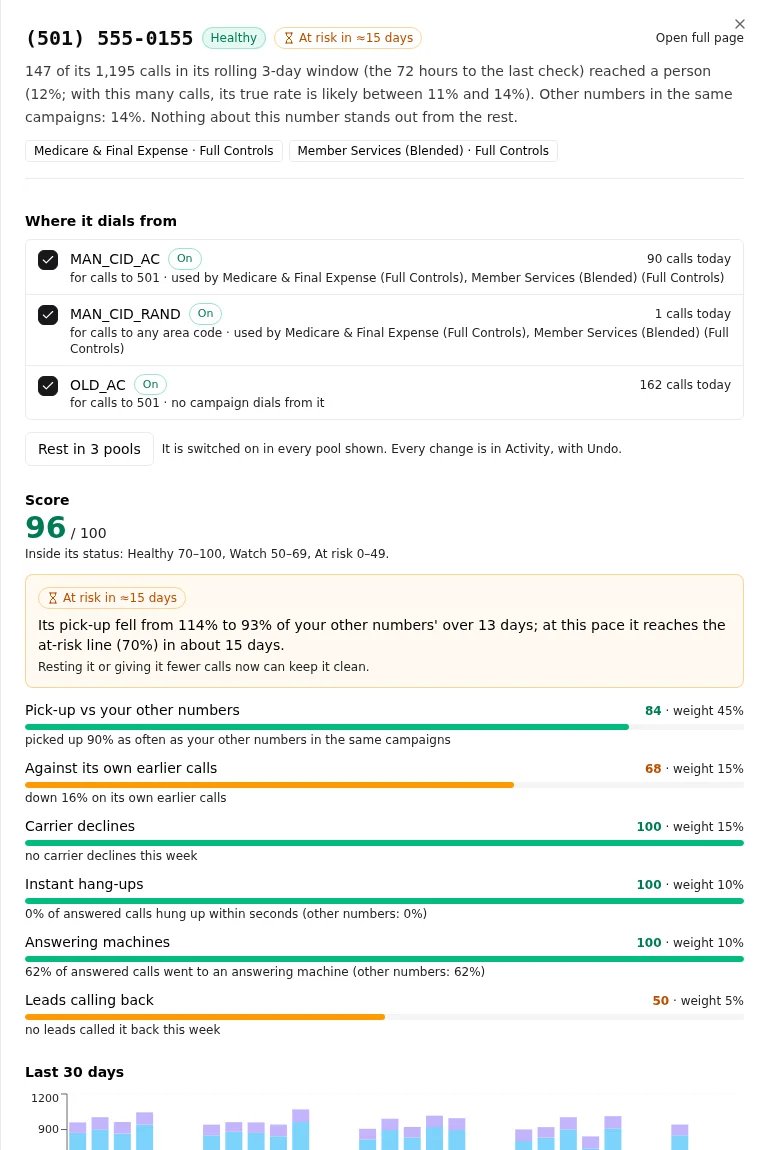
The DID Reputation Center is VICIfast's caller ID health monitor for VICIdial. It reads every outbound call from your server's own call logs, scores each caller ID from 0 to 100 on how often a real person picks up, and warns you when a number is heading for a "Spam Likely" label - before it costs you a week of contacts.
It runs on every VICIfast server. Nothing is installed on the box: it reads the VICIdial database over a read-only connection, once a day at 3 AM on the server's own clock, while the floor is empty, and on demand with the Read now button in the dashboard. It does not sit in the call path, and it does not touch your dialplan, trunks or carrier.
What it adds to a stock VICIdial install:
- a score and status per caller ID (Healthy 70-100, Watch 50-69, At risk 0-49), with the parts the score is made of;
- a burn forecast - "about 6 days left at this pace" - when a number's pick-up is falling steadily;
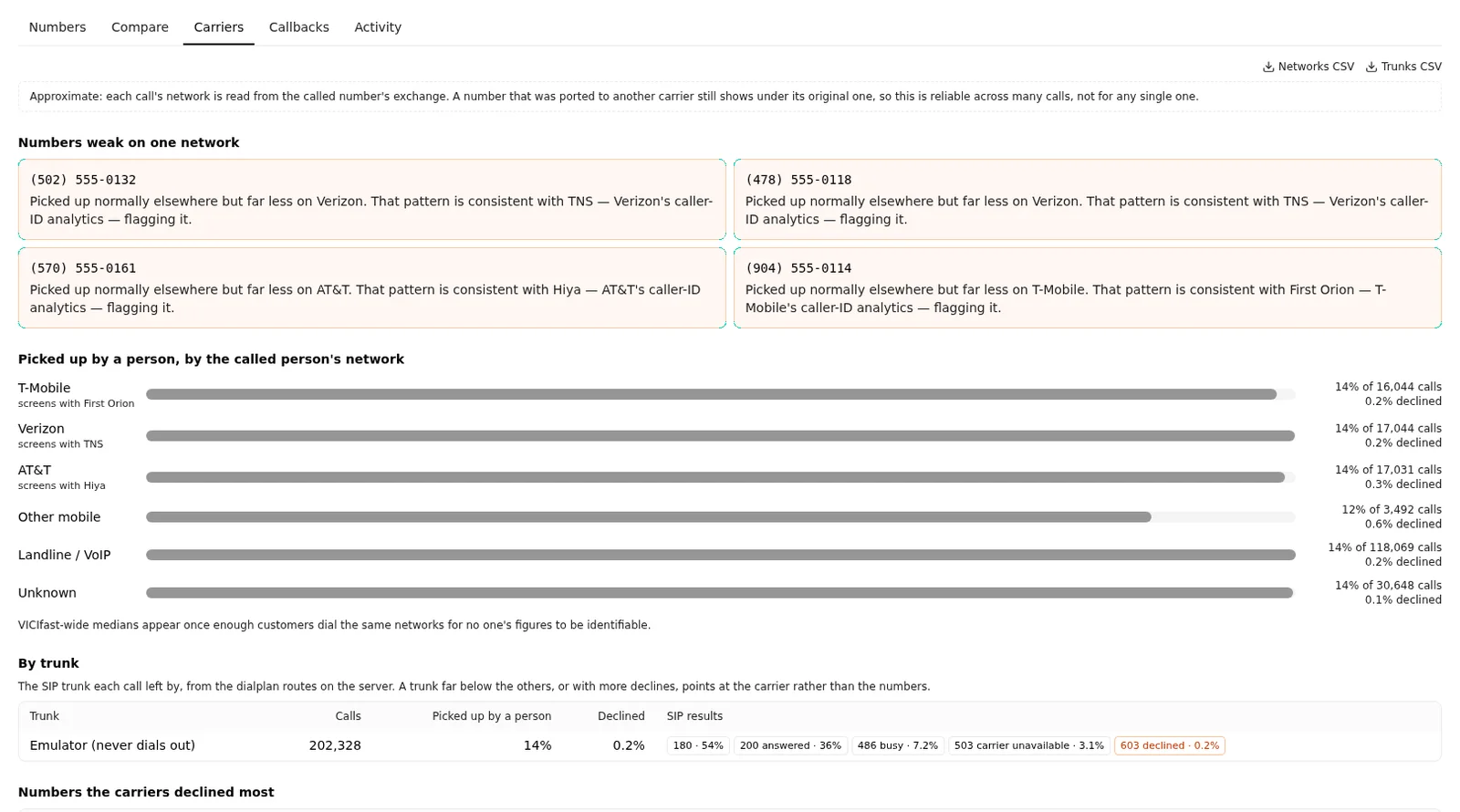
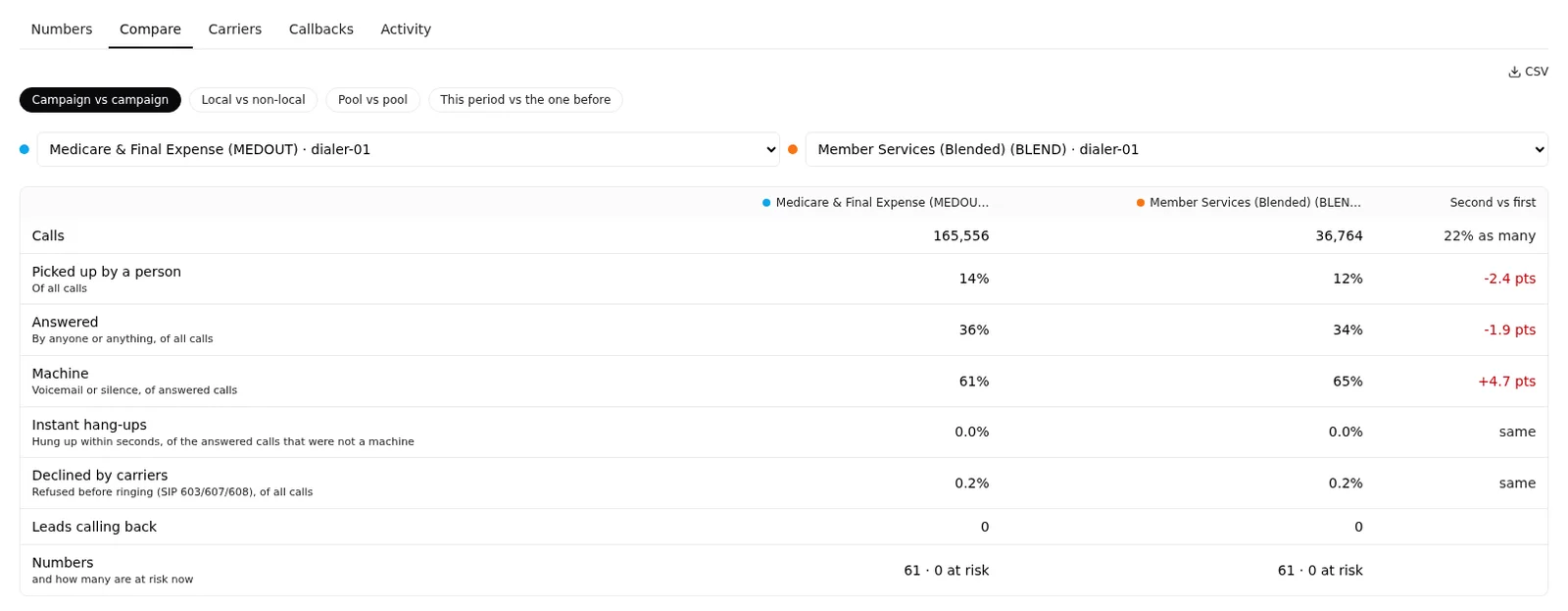
- pick-up by the called person's network (T-Mobile, Verizon, AT&T, other mobile, landline/VoIP) and by SIP trunk, with the SIP results each trunk returned;
- on VICIfast Voice, ring time and STIR/SHAKEN attestation per call;
- caller-name (CNAM) lookups on the numbers you dial from;
- optional Full Controls that rest, test, warm up and - on VICIfast numbers - replace caller IDs inside limits you set.
How can you tell a number is labelled without checking carrier labels?
From the people it calls. When a carrier shows "Spam Likely", fewer people answer. The Center compares how often a person picks up each caller ID against your other numbers in the same campaigns, and against the number's own recent past. A clear, sustained drop is the label's footprint. It is an inference, never a reading of the label itself.
The comparison is what makes it work. A raw answer rate tells you almost nothing - lists differ, hours differ, and most unknown calls go unanswered anyway (86% of them, in Hiya's 2026 survey of 12,000+ consumers). But two numbers dialing the same campaign, the same lists and the same hours should be answered at about the same rate. When one falls well below its siblings, something outside your dialer is treating it differently.
Only a person counts. Voicemail, answering-machine detections and carrier errors are left out, so a list full of disconnected numbers doesn't read as a reputation problem.
It is careful with small numbers. A caller ID with a dozen calls can look terrible by chance, so a number is only flagged when the difference is statistically clear - and each campaign chooses how readily (Conservative, Balanced or Aggressive).
What it cannot do is name the label. If a number is answered normally on three networks and far less on the fourth, that is consistent with the fourth network's analytics labelling it. We say exactly that, and no more.
Why are my calls showing "Spam Likely"?
Because an analytics engine working for the called person's carrier has scored your caller ID as probably unwanted. The score comes from the traffic pattern of that one number - call volume, very short calls, low answer, complaints, little history - not from a single national list, and each network scores it separately.
VICIdial's author, Matt Florell, put it plainly in his 2021 Astricon talk: labels are "based on CallerID phone number", and "a minimum of 5 minutes and 200 phone calls can get you flagged". New numbers are not exempt: Hiya reported in January 2025 that 18% of reported US spam calls came from numbers with minimal call history.
The common causes on a VICIdial floor:
- Too many calls per number. A small caller ID pool on a predictive campaign concentrates hundreds of calls a day on each number.
- Short calls and drops. Abandoned calls and instant hang-ups look like robocalls to a scoring engine, whatever caused them.
- Old or poor lists. Wrong-number complaints feed the engines.
- No local presence. Calling Phoenix from a New York number gets ignored, and unanswered calls count against the number.
The labels themselves - Spam Likely, Scam Likely, Potential Spam, Spam Risk - are compared in Spam Likely vs Scam Likely.
Do T-Mobile, Verizon and AT&T judge my numbers differently?
Yes. Each carrier relies on its own analytics engine, which scores numbers from its own traffic and complaint data. A number can ring clean on AT&T and arrive labelled on T-Mobile. That is why the Center splits pick-up by the called person's network: a gap on one network is the clearest sign of one engine's label.
| Network | Analytics engine | Source |
|---|---|---|
| T-Mobile | First Orion | First Orion, 2018 congressional testimony |
| AT&T | Hiya | GSMA operator profile |
| Verizon | TNS (Call Guardian) | Commonly reported; TNS says 3 of the top 5 US wireless carriers use Call Guardian |
The network is read from the called number's exchange, so a ported number shows under its original carrier. Across hundreds of calls that blurs little; on a handful it can mislead. Treat a network breakdown as evidence across many calls, never as a verdict on one.
What is DID remediation, and does VICIfast do it?
Remediation is asking a carrier or its analytics provider to review the label on a number. It is a request, not a switch: the provider decides, and nobody outside those companies can guarantee the outcome. VICIfast does not file appeals. The Center tells you which numbers to rest, which to appeal, and when one has recovered.
The free routes exist and are worth using:
- The Free Caller Registry, run by First Orion, Hiya and TNS - but only for businesses calling on their own behalf. BPOs, agencies and lead-generation shops calling for clients must go to each provider directly. The registry itself says it "does not guarantee redress" and is "not a replacement for caller reputation monitoring".
- Carrier redress. Under USTelecom's best practices adopted in April 2026, which cover labelled as well as blocked calls, members commit to a conclusion on at least 95% of qualifying requests within 2 business days, at no charge.
Remediation often doesn't stick, because the label came from a calling pattern that is still running. Fix the pattern - fewer calls per number, more local numbers, rest before reuse - or the next review will find the same thing. The step-by-step version, with what a request should contain, is in How to get Spam Likely removed.
How does it tell a blocked call from a labelled one?
A blocked call never rings, and the network says so: analytics-based blocking must now return SIP 603+ with redress contact details. A labelled call rings with a warning and sends nothing back. The Center counts carrier declines per number and per trunk, and infers labels from pick-up - two different signals for two different problems.
A burst of declines on one caller ID is the hardest evidence a network has blocked it - stop dialing it and use the redress contact. A slow fall in pick-up with no declines is the label pattern. The full comparison of SIP 603, 607 and 608 is in SIP 603+ vs Spam Likely.
What does Full Controls do on its own?
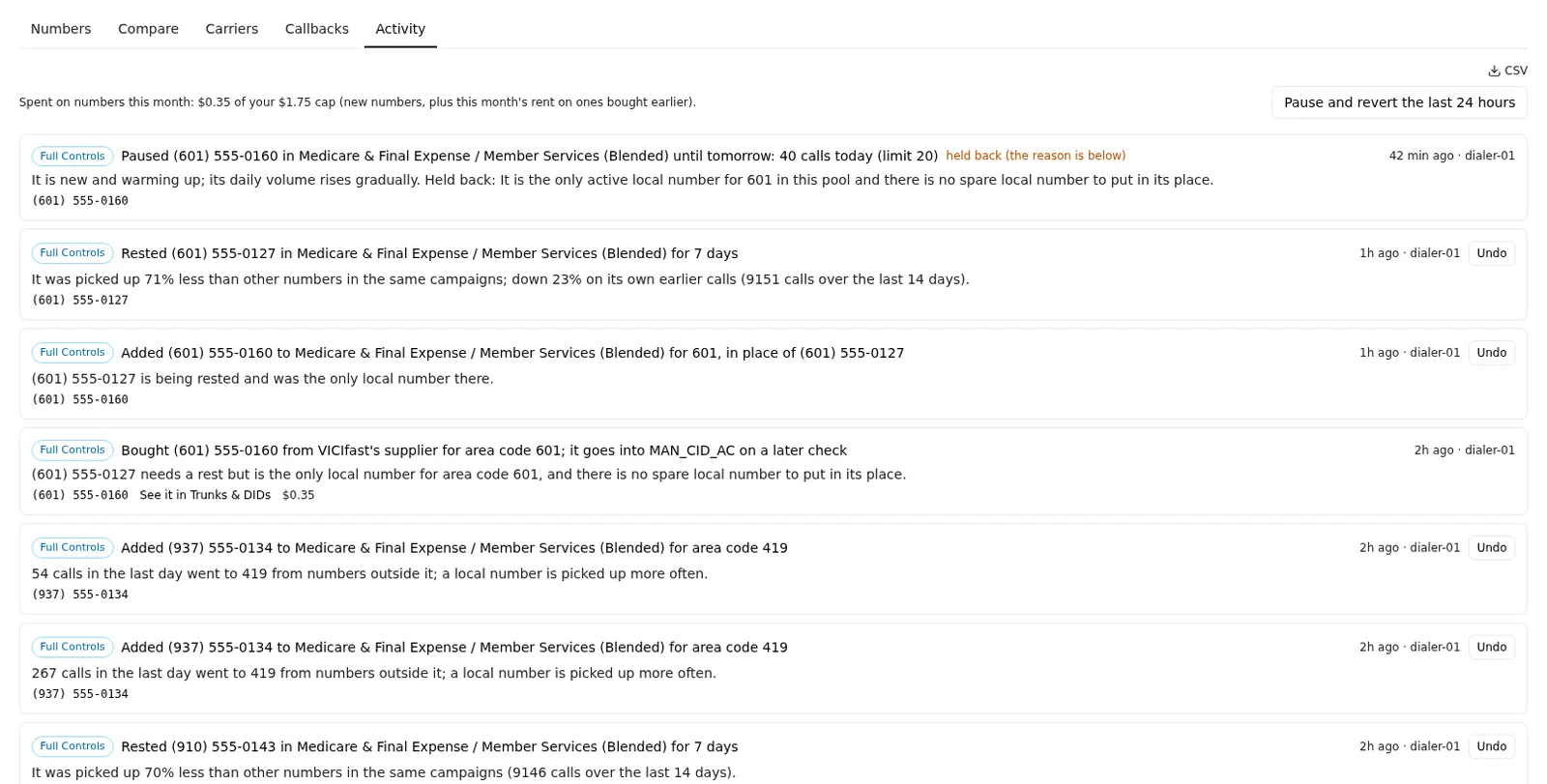
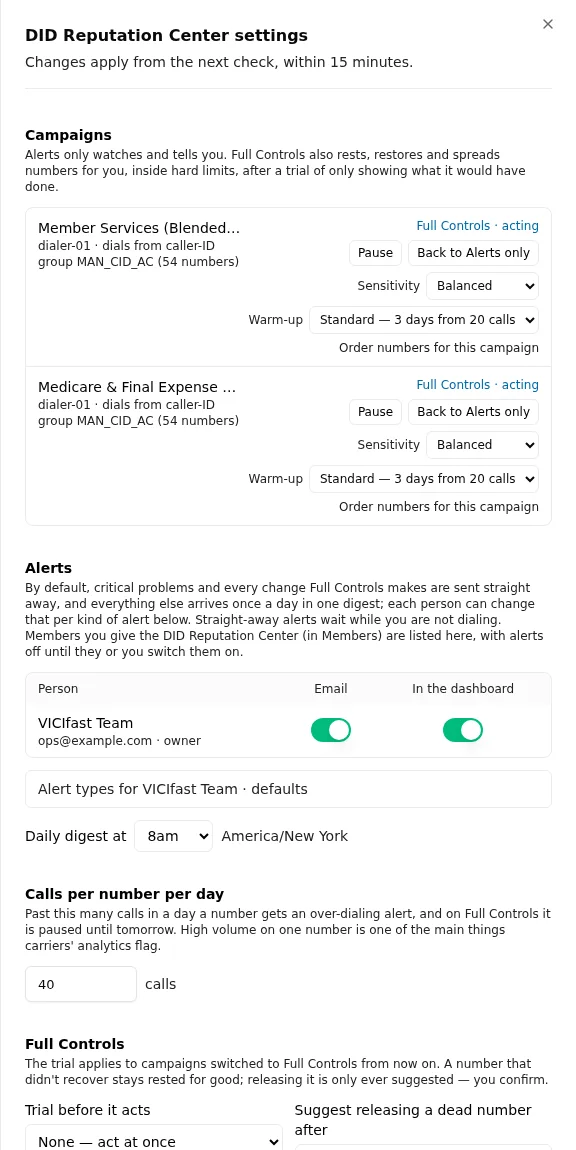
Full Controls acts on what the scores show, per campaign, inside limits you set. It rests a number that's at risk, gives it a few test calls before it returns, warms new numbers up gradually, caps calls per number per day, keeps a local number on for every area code, and - on VICIfast numbers - replaces one that doesn't recover.
Each campaign is on Alerts only (the default - it never touches the dialer) or Full Controls, which starts with a trial you choose (none to 7 days) where it only shows, in Activity, what it would have done.
| What it does | How |
|---|---|
| Rests an at-risk number | Switches its caller ID rows off for 7 days (14 the second time) |
| Tests before return | Brings it back on a small daily quota and compares its pick-up with your other numbers |
| Keeps a failed number out | A number that fails two rounds of test calls stays out; releasing it is suggested after the days you set, and you confirm |
| Warms up new numbers | A new number starts on a small daily share and rises to the full limit over days, holding a step while it lags |
| Caps volume per number | Pauses a number for the day at your per-number limit; weaker numbers get a smaller share, healthy ones carry more |
| Keeps local presence | Never rests the last local number for an area code without a replacement; fills an area code you call often with a spare you own |
| Replaces (VICIfast numbers) | Buys a local number from VICIfast stock or, with none in stock, orders one (area code, then same state), inside a monthly spend cap you set - at most 5 a day |
It only ever writes VICIdial's caller ID rows. Every change is in Activity with Undo, there is a Pause and revert the last 24 hours, and each change is logged in VICIdial's own admin log as user VICIfast.
How do CID groups, AREACODE and failover work in VICIdial?
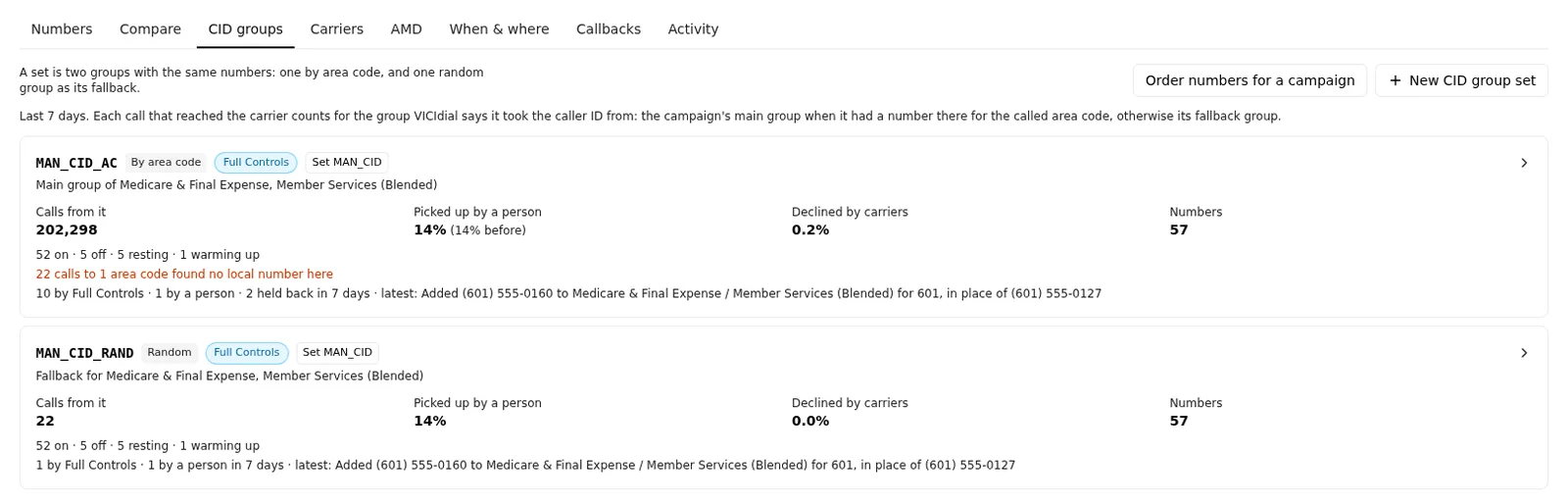
A CID group is a named pool of caller IDs a campaign dials from. An AREACODE group gives each call a number matching the called area code; a NONE group picks any number from the pool. Point the campaign at an AREACODE group, set a NONE group holding the same numbers as its second group, and every call gets one of your numbers.
The Center calls this a CID group set and can create one for you - for example MAN_CID_AC as the campaign's CID group and MAN_CID_RAND as cid_group_id_two:
- A call to a 305 number goes out from a 305 number in MAN_CID_AC, when the set has one.
- A call to an area code with no number of its own falls to MAN_CID_RAND and goes out from one of the set's numbers, not from the campaign's single caller ID.
- Full Controls treats the two groups as one unit: a number is rested, tested and brought back in both together. If it's the only local number for its area code, it waits up to a day for a replacement, then rests anyway - calls to that area code go out from MAN_CID_RAND until the new number arrives.
The VICIdial mechanics, by hand, are in How to rest a flagged caller ID in VICIdial, with background in CID groups, CID group failover and area-code caller ID.
Is DID rotation allowed?
Using more than one caller ID is not, by itself, unlawful today, but "number cycling" is under review. In March 2026 the FCC proposed rules (FCC 26-17) asking whether to prohibit or limit numbers used "on a rotating basis" as few as one or two times, while acknowledging "there may be legitimate uses". As of November 2026 it is a proposal, not a rule.
The rules that already apply don't mention rotation: a telemarketer's caller ID must let the called person make a do-not-call request during business hours (47 CFR 64.1601(e)), and caller ID may not be faked "with the intent to defraud, cause harm, or wrongfully obtain anything of value" (47 CFR 64.1604). Talk to your counsel about your own campaigns.
The Center is built for a stable pool, not for churn:
- numbers you own, each able to take a call back;
- local numbers used because the people you call are local;
- rest and warm-up before replacement;
- replacement only for numbers that don't recover - and free swaps capped at 10% of your VICIfast numbers a month;
- a written record of every change.
That cap is deliberate. It keeps the product from becoming the rotation machine the FCC is asking about. More in The FCC's number cycling proposal, for call centers.
Does A-level STIR/SHAKEN stop spam labels?
No. Attestation A says the originating carrier knows you and that you may use the number - not that anyone wants the call. Almost everything is signed now: TNS found 85% of Tier-1 traffic signed in 2025, 93% of it at A, and up to 13% of traffic from invalid numbers also signed A. So analytics engines can't treat A as safe.
Get A where you can - B, C or unsigned calls start at a disadvantage - but don't expect it to clear a label. On VICIfast Voice the Center shows how each call was actually signed, per number and per trunk, so a B on a number you own shows up as the paperwork problem it is. More in Why A attestation doesn't stop Spam Likely.
How many calls per DID per day is safe?
No carrier or regulator publishes a threshold. Vendors quote rules of thumb between 50 and 100 calls per number per day, but none of them show the data behind it. The safe number is the one where a caller ID's pick-up stays level with your other numbers - and that differs by list, campaign and hour.
The Center lets you set a per-number daily limit (50 by default), alerts you when a number goes past it, and on Full Controls pauses the number for the rest of the day. Health-weighted sharing gives a weaker number a smaller share of the limit, so the healthy numbers carry more of the calls.
We are building a dataset of our own - calls per number per day against pick-up, across VICIfast floors, anonymised - and will publish it here once there is enough of it to mean something.
Are there "spam-free" or "clean" DIDs?
No one can sell a number guaranteed never to be labelled. A new number has no label, but it also has no history, which engines treat with suspicion. What you can control is how a number is introduced, used and retired. That is what the Center manages, and why it never calls a number "clean".
In practice:
- New numbers are warmed up, not put straight to full volume.
- Numbers released in the last 90 days are never bought by Full Controls - a recycled number can arrive carrying its last owner's reputation.
- A VICIfast number that didn't recover can be swapped for a fresh one free - up to 10% of your VICIfast numbers a month, with no early-release fee and the first month free.
- You can buy numbers for a campaign from its own leads: pick a campaign, and a plan sized to the area codes it will dial goes into a MAN_CID set when you approve it.
How does it compare with other caller ID reputation tools?
Most reputation tools check carrier labels on a sample of calls and sell remediation on quote. Dialer suites build reputation into their own dialers. The DID Reputation Center reads every call in your existing VICIdial, publishes its price, and doesn't file appeals. Facts below are from each vendor's own pages, checked 4 November 2026.
| How it detects | Files appeals for you | Published price | Works inside your VICIdial | |
|---|---|---|---|---|
| VICIfast DID Reputation Center | Pick-up on every call from your VICIdial logs, by network and trunk | No | Yes - free view; full center with bare metal and clusters | Yes - native |
| CallerIDReputation | Carrier and app label checks | Yes (support tickets, carrier contact) | No - quote | Lists VICIdial on its quote form |
| Numeracle | Identity verification and monitoring at the 3 major carriers | Yes | No - quote | No |
| Telnyx Number Reputation | API scores and spam-risk level | Paid per request ($1 per number) | Yes - $100/month per account plus $0.10 per check | No - API |
| Readymode | Per-carrier number status inside its own dialer | Managed | Yes - per licence, 5-licence minimum | No - a different dialer |
| Convoso | Flagged-number dashboards inside its own dialer | Number replacement | No - quote | No - a different dialer |
Vendors change their pricing and features; check theirs before you decide. If you already run VICIdial and want to keep it, the choice is mostly between label-checking services that sample, and reading every call you already make.
What does it cost?
The health view is free on every VICIfast server. The full center is not sold on its own: it comes at no charge with VICIfast bare metal servers and clusters, and with Managed Floor Essentials and Enterprise. Cloud servers, shared or dedicated CPU, keep the free health view. VICIfast numbers cost $1.00 a month, $0.75 at 500+ and $0.50 at 1,000+.
| Price | |
|---|---|
| Health view - every number's score and status, last 7 days | Free on every VICIfast server |
| Full DID Reputation Center - alerts, forecasts, network and trunk views, reports, Full Controls | Included with bare metal servers and clusters |
| Managed Floor Essentials and Enterprise | Full center included |
| VICIfast numbers | $1.00/month; $0.75 at 500+; $0.50 at 1,000+ |
| Swapping a VICIfast number that didn't recover | Free, up to 10% of your VICIfast numbers a month |
| Caller-name (CNAM) lookups | Included in the full center |
You keep your own SIP carrier if you want to: monitoring and Full Controls work on any caller ID in your VICIdial. Buying replacements, free swaps, ring time and attestation per call need VICIfast numbers or VICIfast Voice.
What it will not do
Being plain about the limits is part of the product:
- It does not read carrier labels or show what a called person sees. It infers likely labels from pick-up.
- It does not remove, appeal or "whitelist" labels, and nobody can promise you spam-free numbers.
- It does not make your calls compliant with the TCPA or any other rule.
- It does not rotate numbers to dodge labels, and it caps replacements.
- It does not place, block or reroute calls, or change your dialplan.
Sources
- Hiya, State of the Call 2026: https://www.hiya.com/state-of-the-call
- Hiya, "Hiya fights number rotation," 16 Jan 2025: https://blog.hiya.com/hiya-fights-number-rotation
- Matt Florell, "Carrier Scam Call Flagging," Astricon, 3 Nov 2021: https://www.vicidial.org/presentations/MattFlorell_Astricon_2021_CarrierScamCallFlagging.pdf
- Free Caller Registry (First Orion, Hiya, TNS), accessed 4 Nov 2026: https://www.freecallerregistry.com/
- USTelecom, redress best practices, adopted 15 Apr 2026: https://ustelecom.org/?p=16800
- FCC, NPRM FCC 26-17, "Combatting Illegal Robocalls Through FCC Numbering Policies," adopted 26 Mar 2026: https://docs.fcc.gov/public/attachments/DOC-419249A1.pdf
- Federal Register, FCC 26-17, 8 May 2026: https://www.federalregister.gov/documents/2026/05/08/2026-09134
- FCC Eighth Report and Order, FCC 25-15 (SIP 603+), summary of 4 Mar 2026: https://mslawgroup.com/fcc-call-blocking-grace-period-is-ending-are-you-ready-for-sip-code-603/
- TNS, "2026 Robocall Report: going further than STIR/SHAKEN," 20 Feb 2026: https://tnsi.com/resource/com/tns-2026-robocall-report-going-further-than-stir-shaken-blog/
- eCFR, 47 CFR 64.1601 and 64.1604: https://www.ecfr.gov/current/title-47/chapter-I/subchapter-B/part-64/subpart-P/section-64.1601
- CallerIDReputation pricing page, accessed 4 Nov 2026: https://www.calleridreputation.com/pricing
- Telnyx Number Reputation pricing, accessed 4 Nov 2026: https://developers.telnyx.com/docs/number-reputation/pricing
- Readymode pricing, accessed 4 Nov 2026: https://readymode.com/pricing
- Numeracle, accessed 4 Nov 2026: https://www.numeracle.com/
- Convoso help center, "Replacing existing DIDs with new ones," accessed 4 Nov 2026: https://help.convoso.com/hc/en-us/articles/360000362334-Replacing-Existing-DIDs-with-New-Ones
Go deeper
- How to get Spam Likely removed from your number →
- How to rest a flagged caller ID in VICIdial →
- Spam Likely vs Scam Likely: what each label means →
- Why A attestation doesn’t stop Spam Likely →
- SIP 603+ vs Spam Likely: blocked or labelled calls →
- The FCC’s number cycling proposal, for call centers →
- CID Groups: rotating caller IDs across a campaign →
- CID Group failover explained →
