What an inbound in-group is in VICIdial
An in-group is the bucket that connects incoming calls to your agents. If you want a phone number to ring people on the floor, you need one. Here is what it does and why it exists.
If you just set up VICIdial and you want a phone number to actually ring someone on your team, the piece you are looking for is the in-group. It is the small but important bridge between a call arriving at your server and a live person picking it up. Without one, an inbound call has nowhere to land.
The bucket calls wait in
flowchart LR
    A[Phone number / DID] --> B[Inbound in-group]
    B --> C[Holds and queues call]
    C --> D{Agent available?}
    D -->|Yes| E[Route to agent on floor]
    D -->|No| F[Wait in queue]
    F --> D
    E --> G[Agent answers caller]
Think of an Ingroup as a labeled bucket. Calls drop into the bucket, agents reach into it, and VICIdial decides who gets the next one. Each bucket has its own name, its own rules, and its own queue behavior. You might have one bucket for sales, one for support, and one for billing, all running on the same server at the same time.
Two kinds of traffic flow into in-groups. The first is real inbound calls coming from a phone number you own, which arrive through a DID (a DID (direct inward dialing) is the actual telephone number people dial). The second is transferred calls handed off by a fronter on another campaign, which is why in-groups are sometimes called closer groups. A Closer takes those warm hand-offs.
What lives inside one
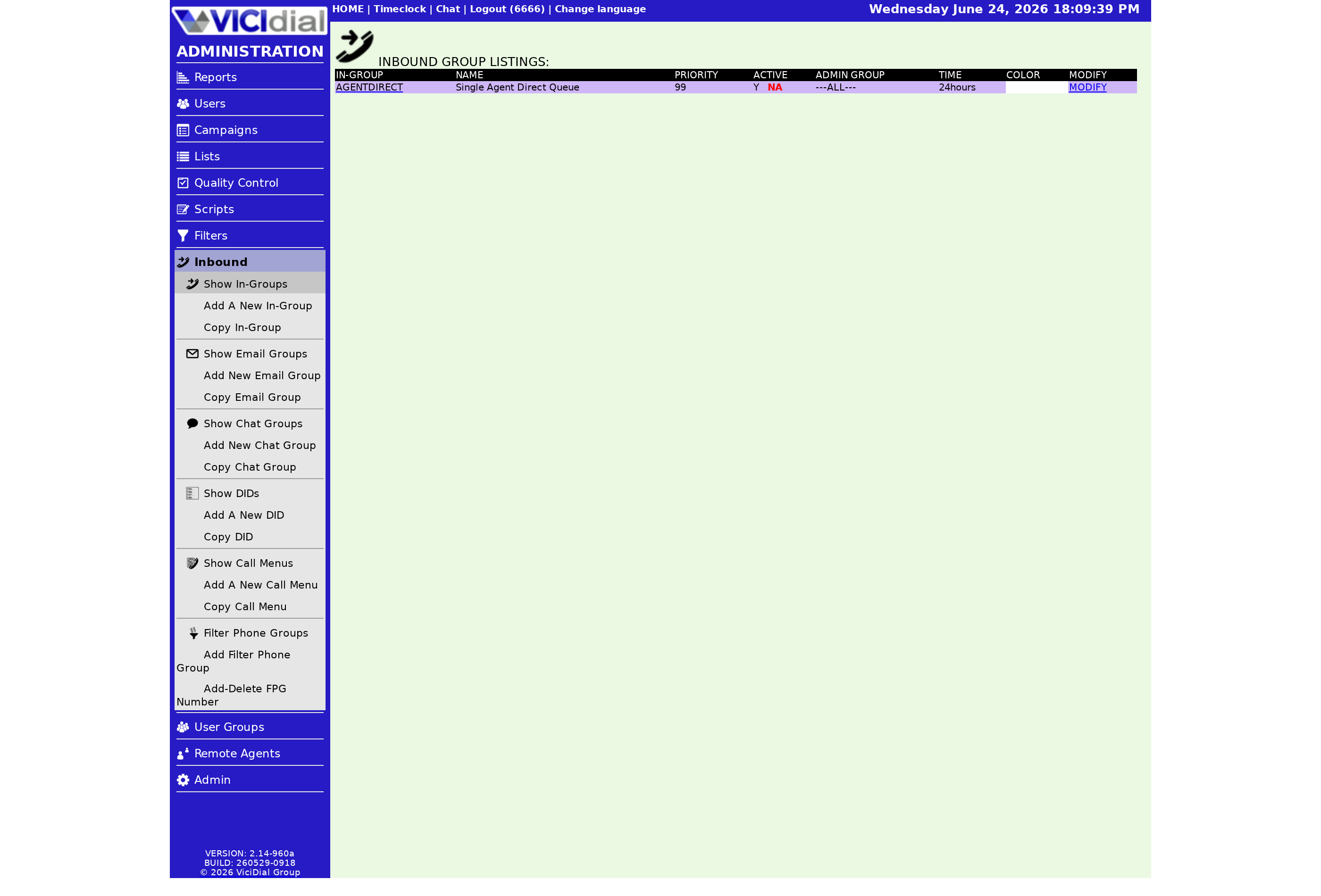
Each in-group carries a short ID, a friendly name, a ranking priority that decides which bucket gets served first when several have calls waiting, an active flag, and a display color. The color is handy on the floor because it tells agents at a glance which line a call came in on without reading the fine print.
The in-group also stores the logic for picking who answers. When two agents are free, the Next agent call rule breaks the tie, choosing for example the person who has waited longest or the one with the fewest calls so far. You set this per bucket, so sales can route differently from support.
How agents reach the calls
An agent does not log directly into an in-group. They log into a campaign and check a box for each in-group they are allowed to take calls from. That is why a brand-new in-group can show a red NA in the list: it exists, but no campaign has been told to use it yet. Once a campaign allows it, the agent's Status (lead status) flips to waiting and calls start flowing.
If you are still mapping out how the inbound side fits together, the inbound call handling guide walks through the whole chain, and once you understand the concept the next practical step is adding your first in-group.
The good news is that none of this requires you to babysit a server. On our managed VICIdial hosting, you get a working box in under a minute and spend your time on in-groups and routing instead of installs.
Frequently asked
- No. In-groups are only for calls coming in. A pure outbound campaign does not require one, but the moment you want to take inbound or closer calls, you need at least one in-group.
- A red NA in the Active column means the in-group is not allowed in any campaign yet. Agents log into a campaign, and the campaign decides which in-groups they can pull calls from. Add it to a campaign and the NA goes away.
› Do I need an in-group for outbound-only calling?
› Why does my in-group show a red NA?
Related from VICIfast
About VICIfast
We run VICIdial servers for call centres, so you don’t have to. You get the dialer set up, secured and kept running — we handle the server, the updates and the backups. Bring your own phone carrier; we never resell minutes. From $49 a month per server.
Questions? Call +1 636 556 0022 and talk to someone who runs dialers.
Citing this article
VICIfast Engineering. “What an inbound in-group is in VICIdial”. VICIfast LLC, June 19, 2026. Retrieved from https://vicifast.com/blog/what-is-vicidial-inbound-group
Have questions?
Related posts
You might be interested in
VICIfast newsletter
Liked this? Get the next one in your inbox.
We ship the kind of stuff you just read - concrete, numbers-first, no drip. One email when a new post goes live. Unsubscribe in one click.
Comments
No comments yet - be the first.